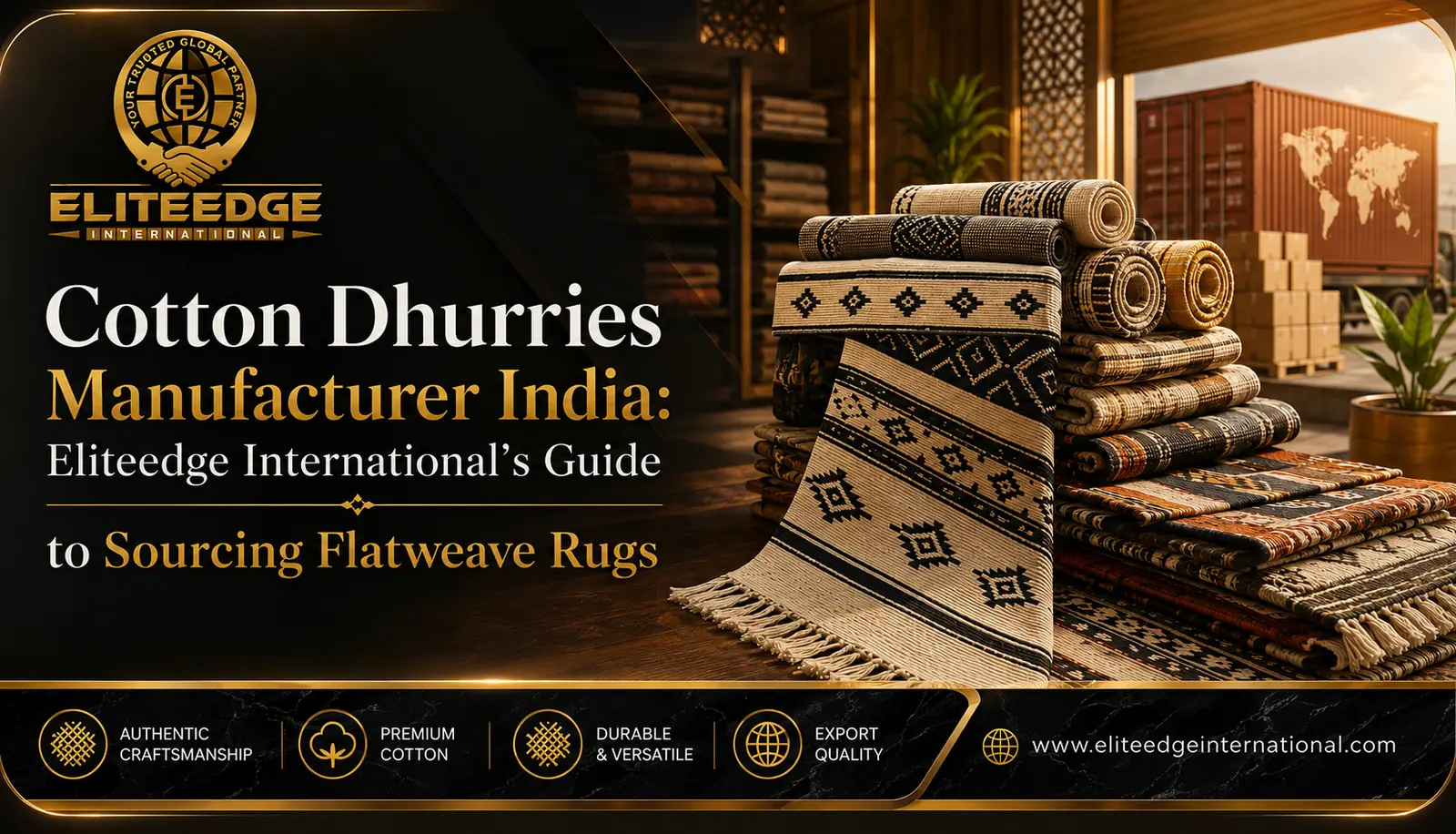
The flatweave category occupies a genuinely useful middle ground in most rug catalogs, offering a lighter, more casual alternative to a thick pile rug at a typically more accessible price point. A cotton dhurries manufacturer India partner produces exactly this kind of product, a traditional Indian flatweave rug construction that has found strong contemporary appeal for its reversibility, easy care, and versatile styling across both traditional and modern interiors. This guide explains what defines a dhurrie specifically, how flatweave construction differs from pile rugs in practical terms, and what buyers should evaluate before sourcing this category at wholesale scale, so a retail assortment decision rests on genuine category understanding rather than assumption.
At Eliteedge International, dhurries and other flatweave designs are produced with the specific tension and finishing techniques this construction method requires, distinct from the tufting and knotting processes used for pile rug categories, and the team can walk through exactly how these techniques differ if a buyer wants that level of production detail.
What Defines a Dhurrie as a Distinct Rug Category
A dhurrie is a traditional flatweave rug originating from India, historically woven from cotton on a simple horizontal loom using an interlocking weft technique that produces a flat, pileless surface rather than the raised pile associated with hand tufted or hand knotted construction. This flat construction gives dhurries their characteristic lightweight feel and, in most designs, genuine reversibility, since the weave pattern typically appears nearly identical on both sides of the finished rug, unlike a pile rug where the backing side looks entirely different from the visible pile surface. This distinctive construction has made dhurries a staple of Indian textile tradition for generations, long before the category found renewed popularity in contemporary international home decor markets.
Traditional Patterns Versus Contemporary Dhurrie Designs
Traditional dhurrie patterns often feature geometric motifs, stripes, and bold color blocking rooted in regional Indian textile traditions, while contemporary dhurrie designs increasingly incorporate more muted, design forward color palettes and simplified patterns aimed at a broader international home decor market. Buyers should clarify with their manufacturer which design direction, traditional or contemporary, best fits their specific retail positioning, since dhurrie manufacturers often maintain distinct design lines catering to each aesthetic preference. Understanding which direction resonates with your specific customer base before committing to a bulk order helps avoid stocking inventory that does not align well with your store's overall aesthetic positioning.
Cotton Versus Wool Dhurrie Construction
While cotton remains the most traditional and common dhurrie material, wool dhurries are also produced, offering a somewhat more substantial feel and better insulation properties while retaining the flat, reversible weave characteristic of the category. Cotton dhurries generally offer easier machine washability for smaller sizes and a more casual, breathable feel, making them popular for warmer climates or more casual interior settings, while wool dhurries suit buyers wanting some added warmth and durability within the flatweave format. Buyers building a full seasonal collection sometimes stock both material options, offering cotton designs for warmer months and wool designs positioned as a cozier cold weather alternative within the same flatweave category.
Flatweave Rugs Exporter India: How This Category Differs From Pile Construction
Working with a flatweave rugs exporter India partner means sourcing a fundamentally different construction category than the hand tufted or hand knotted pile rugs covered elsewhere in this guide series, with distinct implications for durability, care, and appropriate use case that buyers should understand clearly before building a retail assortment around this category. Treating flatweave as simply a cheaper version of pile construction, rather than a genuinely different product with its own strengths, tends to produce mismatched customer expectations down the line.
Durability Trade Offs of Flatweave Construction
Flatweave rugs generally show wear differently than pile rugs, since there is no pile height to crush or wear down over time, though the flat weave structure itself can loosen or fray at edges under heavy, sustained foot traffic if not properly finished. This makes flatweave rugs particularly well suited to lower to moderate traffic areas such as a dining room, bedroom, or layered accent placement, while a busy entryway or high traffic hallway may be better served by a more durable pile or specifically engineered entrance mat construction covered elsewhere in this guide series. Understanding this durability profile upfront helps buyers position dhurries accurately within a broader assortment rather than promising performance the construction method was never designed to deliver.
Care and Cleaning Advantages of Flatweave Rugs
Flatweave rugs are generally easier to clean than pile rugs, since there is no deep pile for dirt and debris to become trapped within, and many smaller cotton dhurrie designs can even be machine washed at home, a significant convenience advantage over rugs requiring professional cleaning. Eliteedge International's flatweave rugs exporter India catalog includes designs specifically suited to home washing alongside larger pieces intended for professional cleaning, giving buyers flexibility across different size and use case requirements.
Sourcing Dhurries Alongside Other Product Categories
Buyers building a diversified home textiles catalog often find that dhurries pair naturally with other flatweave and casual home goods categories, since the material sensibility and price point tend to appeal to a similar customer segment across several related product types. A retailer who already stocks casual cotton throws, table linens, or similar lightweight home textiles may find that a dhurrie line integrates smoothly into that existing aesthetic and customer relationship, expanding the retailer's footprint within a category the customer already trusts them for. This kind of natural category extension often performs better than launching an entirely unrelated product line, since it leverages an existing customer relationship rather than building trust from scratch.
Building a Coordinated Home Textiles Assortment
Coordinating dhurrie colors and patterns with other home textiles in a retailer's broader assortment, whether through matching color palettes or complementary pattern styles, can create a more cohesive shopping experience that encourages customers to purchase multiple coordinated items rather than a single standalone rug. Sharing your broader assortment strategy with a manufacturer experienced in textile coordination can surface design suggestions a buyer might not have considered independently, since a manufacturer working across multiple related categories often develops a useful perspective on which combinations perform well at retail.
Seasonal Merchandising Opportunities for Dhurries
Dhurries, with their lighter weight and often brighter, more casual color palettes, frequently perform well in spring and summer seasonal merchandising, offering retailers a natural opportunity to refresh their rug offering with the season rather than treating rugs as a purely evergreen category. Eliteedge International can discuss seasonal design trends and timing considerations for buyers planning a dhurrie launch around a specific merchandising calendar.
Reversibility as a Genuine Product Advantage
Many dhurrie designs are woven so that both sides display an attractive, usable pattern, giving customers genuine flexibility to flip the rug for a different look or to extend its usable lifespan by rotating which side faces up as one side experiences more wear or sun fading than the other. This reversibility is a real functional benefit worth highlighting in retail marketing, though buyers should confirm with their manufacturer whether a specific design is genuinely reversible or simply finished neatly on the back without an intentional second usable pattern. This distinction matters enough to verify directly with a physical sample rather than relying solely on a manufacturer's general product description.
Marketing Reversibility Honestly to Retail Customers
Retailers should verify reversibility claims with a physical sample before featuring this benefit prominently in marketing materials, since not every flatweave design offers a genuinely equivalent pattern on both sides, and overstating this feature can lead to customer disappointment if the reverse side turns out to be a plain or unfinished surface rather than a true second design. This modest verification step protects the credibility of a retailer's broader marketing claims across their entire catalog, not just the specific dhurrie design in question. Eliteedge International can confirm reversibility details directly for any specific design under consideration.
Custom Sizing and Color Options for Dhurrie Programs
Dhurries lend themselves well to custom sizing given their relatively straightforward flatweave construction, and many manufacturers can accommodate a range of custom dimensions and color combinations without the more significant lead time increase that custom pile rug work often requires. This relative ease of customization makes dhurries a particularly practical starting point for a retailer's first custom or private label rug project.
How Eliteedge International Approaches Flatweave Production
Eliteedge International, based in Jalgaon, Maharashtra, produces cotton and wool dhurries alongside its hand tufted rug, hand knotted carpet, and polypropylene mat catalogs, with weaving and finishing techniques specific to the flatweave construction method. The team can advise on traditional versus contemporary design directions, material choice, and sizing to match a buyer's specific retail strategy, drawing on direct production experience across the full range of construction methods this guide series covers.
Buyers can request samples across different dhurrie patterns and materials before committing to a bulk order, comparing traditional and contemporary options along with cotton and wool material choices directly against each other. Reach out as a cotton dhurries manufacturer India partner to start the conversation with the export team directly.
Buyers new to the flatweave category sometimes underestimate how differently dhurries perform and are cared for compared to the pile rug categories they may already be familiar with, which can lead to mismatched customer expectations if a dhurrie is marketed identically to a plush hand tufted rug rather than positioned accurately as a lighter, more casual, and generally more affordable alternative within a broader rug assortment. Taking the time to understand and accurately communicate these category specific characteristics helps retailers build a flatweave product line that performs well against realistic customer expectations rather than comparisons to a fundamentally different construction method. This same principle of accurate, category specific positioning applies across every product line covered throughout this broader guide series, since each construction method and material genuinely serves a different purpose within a well balanced retail catalog.
Frequently Asked Questions
What is the difference between a dhurrie and a regular pile rug?
A dhurrie is a flatweave rug with no raised pile, woven using an interlocking weft technique that produces a flat, typically reversible surface, while a regular pile rug, whether hand tufted or hand knotted, features raised yarn creating a plush or textured surface with distinct front and back sides. This construction difference affects nearly every practical aspect of the two categories, including weight, thickness, durability under heavy traffic, and cleaning method, with dhurries generally being lighter, easier to clean, and better suited to lower traffic applications. Buyers should think of dhurries and pile rugs as genuinely distinct product categories serving different use cases within a broader retail assortment, rather than simply different price points of the same underlying product. Requesting samples of both categories helps illustrate these differences clearly for retail staff who will be communicating them to customers.
Are cotton dhurries machine washable?
Many smaller cotton dhurrie designs can be machine washed at home, which is a significant convenience advantage over rugs requiring professional cleaning, though washability depends on the specific size, construction, and any dyes used in a given design. Larger dhurries generally exceed practical home washing machine capacity and should be professionally cleaned instead, similar to other larger area rugs. Buyers should confirm specific care instructions with their manufacturer for each design rather than assuming all cotton dhurries share identical washability, since construction details and dye stability can vary between designs. Providing clear, accurate care instructions to retail customers at the point of sale helps ensure dhurries are cleaned appropriately and perform as expected over their usable lifespan.
What is the minimum order quantity for a cotton dhurries manufacturer India relationship?
Minimum order quantities depend on the specific pattern, size, and whether custom colors are involved, with standard catalog dhurrie designs generally carrying lower minimums than fully custom patterns requiring new production setup. Dhurries often support relatively accessible minimums compared to hand knotted pile rugs, given the comparatively faster flatweave production process, though this varies by specific manufacturer and design complexity. Sharing your target quantity, preferred pattern style, and any customization requirements directly with the manufacturer allows them to quote an accurate minimum for your specific situation. Many buyers start with a smaller trial order to confirm quality and colorfastness before committing to a larger repeat program.
Are dhurries genuinely reversible, or is that just a marketing claim?
Genuine reversibility depends on the specific design and weaving technique used, with many traditional dhurrie patterns woven so both sides display an attractive, usable pattern, while other designs may be finished neatly on the back without an intentional second usable pattern. Buyers should request a physical sample and examine both sides directly before featuring reversibility prominently in their own retail marketing, rather than assuming every dhurrie design offers equivalent patterns on both faces. A manufacturer experienced with dhurrie construction should be able to confirm specifically whether a given design is genuinely reversible or simply neatly finished on the reverse side. Verifying this claim firsthand protects retailers from overstating a feature that could disappoint customers if the reverse side turns out to be less usable than marketing language implied.
How durable are flatweave dhurries compared to pile rugs in high traffic areas?
Flatweave rugs generally perform differently than pile rugs under heavy traffic, since there is no pile height to crush or wear down, though the flat weave structure itself can loosen or fray at edges under sustained heavy foot traffic if not properly finished with secure edge binding. This makes flatweave rugs particularly well suited to lower to moderate traffic areas such as a dining room, bedroom, or layered accent placement, while a busy entryway or high traffic commercial area may be better served by a more durable pile rug or a specifically engineered entrance mat construction. Buyers sourcing for a specific traffic level should discuss expected use case with their manufacturer to confirm the dhurrie construction and edge finishing quality is appropriate for that application. Requesting a sample and examining edge construction quality directly gives useful insight into how well a specific design will hold up under its intended use.
What color and pattern customization is available for dhurrie orders?
Dhurries lend themselves well to custom sizing and color combinations given their relatively straightforward flatweave construction, and many manufacturers can accommodate a range of custom requests without the more significant lead time increase that custom pile rug work often requires. Buyers can typically request custom colorways matched to a brand palette, along with size adjustments to fit a specific retail display or use case. Sharing your specific color and pattern requirements early in the conversation helps the manufacturer confirm feasibility and provide an accurate quote and timeline. Requesting a sample of any custom color or pattern before finalizing a bulk order allows you to verify the finished product matches your requirements accurately.
Should I stock dhurries alongside pile rugs, or do they compete for the same customer?
Dhurries and pile rugs generally serve different customer needs and use occasions rather than directly competing for the same purchase decision, since dhurries typically appeal to buyers wanting a lighter, more affordable, and easier to maintain option, while pile rugs appeal to buyers prioritizing plushness, warmth, and a more substantial standalone floor covering. Many successful retail catalogs stock both categories side by side, allowing customers to choose based on their specific room, budget, and maintenance preferences rather than forcing a single rug category to serve every possible use case. Positioning both categories clearly, with accurate descriptions of their distinct characteristics, helps customers self select the right product for their specific need rather than creating confusion between genuinely different product types. Sourcing both categories from a single manufacturer relationship, where available, simplifies vendor management for retailers building this kind of tiered assortment across multiple construction methods and price tiers.
Does Eliteedge International offer both traditional and contemporary dhurrie designs?
Yes, the company produces both traditional dhurrie patterns rooted in regional Indian textile traditions and contemporary designs featuring more muted, design forward color palettes aimed at a broader international home decor market. The team can advise on which design direction best fits a buyer's specific retail positioning and target customer segment. Buyers can request samples across different dhurrie patterns and materials before committing to a bulk order, comparing traditional and contemporary options directly to determine which better fits their catalog. Sharing your specific customer base and existing product aesthetic early in the conversation helps the team recommend design options that will integrate well with your broader retail assortment.
Conclusion
Sourcing from a genuine cotton dhurries manufacturer India partner means understanding flatweave construction as a genuinely distinct category from pile rugs, with its own durability profile, care requirements, and reversibility characteristics worth communicating accurately to retail customers. Eliteedge International produces both traditional and contemporary dhurrie designs in cotton and wool alongside its hand tufted, hand knotted, and polypropylene mat catalogs. Whether you are adding your first flatweave line or expanding an existing dhurrie assortment, the production team is ready to walk through patterns, materials, and pricing with you directly.
If you are ready to request samples or discuss a full export quote, reach out for flatweave rugs exporter India pricing and describe your target product, quantity, and destination market. The team will respond with documentation, lead times, and sample availability so you can move forward with confidence, whether you are sourcing traditional patterns, contemporary designs, or a combination of both.