The phrase sustainable carpet exporters India represents more than a search term for international buyers looking for floor coverings. It reflects a major change in the way carpets are designed, manufactured, tested, packaged, and delivered to global markets. Buyers today increasingly want attractive carpets that also demonstrate responsible use of materials, energy, water, labor, and production resources. India is particularly well positioned in this movement because its carpet sector combines generations of handmade craftsmanship with modern manufacturing capabilities. The Carpet Export Promotion Council, established by the Ministry of Textiles, supports India's handmade carpet and floor-covering export industry and represents a large network of exporters and related businesses. At the same time, government initiatives are placing greater attention on green technology, recycling, waste reduction, and environmentally sustainable production practices across textiles. This makes the modern Indian carpet factory very different from the simple image of a weaving workshop. Today, sustainability can begin with the selection of fiber and continue through yarn preparation, dyeing, weaving, finishing, inspection, packaging, and shipment. For buyers, understanding this complete journey makes it easier to identify suppliers whose sustainability claims are supported by practical manufacturing methods rather than marketing language alone.
Why Sustainable Carpet Manufacturing Matters
A carpet may look simple when it is lying on a floor, but its environmental footprint can involve many stages before it reaches a customer's home, hotel, office, or retail store. Fibers must be sourced, converted into yarn, colored, woven or tufted, finished, inspected, packed, transported, and eventually maintained by the end user. Each stage presents an opportunity to reduce waste or improve resource efficiency. Sustainable carpet manufacturing therefore means looking at the entire production chain rather than focusing only on whether a carpet contains a natural fiber. A wool carpet, recycled polyester rug, jute floor covering, or polypropylene mat can each have different sustainability characteristics depending on how the raw materials are sourced and processed. Indian manufacturers are increasingly responding to this broader understanding of sustainability through material innovation, responsible production, recycling, water management, renewable energy, and certification programs. Government information published in March 2026 specifically highlighted sustainable practices in India's carpet sector, including vegetable dyes, organic wool, and environmentally friendly processes. The goal is not simply to make a “green” product. It is to create a production system that uses resources intelligently while maintaining durability, quality, worker welfare, and commercial viability. That balance is particularly important for exporters because international buyers often require consistent specifications, documentation, testing, traceability, and responsible supply-chain practices.
The Growing Demand for Eco-Friendly Carpets
Global buyers are becoming more careful about what sits behind a product label. A retailer purchasing hundreds or thousands of rugs may need to answer questions about recycled content, chemical safety, worker conditions, environmental management, packaging, and product durability. Consequently, sustainable sourcing has become part of supplier evaluation rather than an optional marketing feature. Research and industry publications also show growing attention to ethical certification in the Indian handmade carpet sector, with standards such as GRS, GoodWeave, SA8000, SEDEX, and related programs used to address environmental and social concerns. This shift creates an important opportunity for sustainable carpet exporters India because the country's manufacturing ecosystem can combine handmade techniques with modern compliance systems. An eco-conscious buyer may want a carpet made from responsibly sourced wool, recycled fibers, natural materials, or certified inputs, but that buyer may also expect reliable colorfastness, dimensional accuracy, strength, safe chemical usage, and consistent delivery. Sustainability cannot compensate for poor product quality. In fact, the strongest sustainable carpet suppliers understand that durability itself can support sustainability because a product that performs well for many years does not need to be replaced as frequently. The modern buyer is therefore looking for a complete package: thoughtful materials, efficient manufacturing, ethical working practices, dependable quality, and transparent documentation.
How Indian Carpet Manufacturing Is Evolving
India has a long-established reputation for handmade carpets, particularly in production clusters such as Bhadohi and other important weaving regions. CEPC describes India as a world leader in handmade carpets and states that its membership includes more than 2,000 exporter members across major carpet-producing clusters. This heritage provides Indian manufacturers with an unusual advantage: sustainability does not necessarily require abandoning traditional production. Hand knotting, hand weaving, and hand tufting can coexist with modern material selection, process control, testing, renewable-energy systems, responsible dyeing, and improved packaging. The evolution is therefore not simply from “traditional” to “modern.” Instead, successful exporters are combining useful elements from both worlds. Craftsmanship provides design depth, flexibility, and cultural value, while modern systems provide repeatability, testing, documentation, and efficiency. Some Indian manufacturers have also introduced recycled materials, solar power, water recycling, natural-yarn products, and resource-management systems into their operations. Industry examples demonstrate that sustainability can be integrated into both the factory infrastructure and the finished product. For an overseas buyer, this combination can be particularly valuable. It allows a supplier to produce carpets with the character expected from Indian craftsmanship while meeting the increasingly detailed expectations of international sourcing teams.
India’s Strength in Handmade and Export Carpets
The strength of Indian carpet manufacturing comes from its broad combination of artisan knowledge, raw-material availability, design capability, export infrastructure, and established international relationships. CEPC continues to organize international trade activities and supports Indian carpet exporters in market access, quality, policy, and sustainable business practices. This ecosystem matters because sustainability is difficult to achieve when a manufacturer operates in isolation. Export-oriented suppliers need access to testing facilities, certification systems, trained workers, compliant materials, packaging suppliers, logistics partners, and international market information. India has developed a substantial ecosystem around these requirements. The Indian Institute of Carpet Technology, for example, provides technical support and laboratory services for carpet and textile testing, while research programs have explored natural fibers, natural dyeing, recycling of carpet waste, and other sustainable applications. For buyers, this means that sustainable sourcing from India can involve more than purchasing a product described as eco-friendly. It can involve building a documented supply chain in which material choices, manufacturing methods, testing, quality management, and export procedures are connected. That is where experienced sustainable carpet exporters India can create significant value for international brands.
Step 1 – Selecting Sustainable Carpet Materials
The manufacturing journey begins long before the loom starts moving. Material selection determines many characteristics of the finished carpet, including appearance, durability, maintenance requirements, recyclability, and potential environmental impact. Depending on the product, manufacturers may work with wool, cotton, jute, hemp, viscose, polypropylene, polyester, recycled fibers, or blends. The right material depends on the intended application. A luxury residential rug may require softness and visual richness, while a high-traffic commercial carpet may prioritize abrasion resistance and dimensional stability. Outdoor rugs and mats may need moisture resistance and UV stability. Sustainable manufacturing therefore does not mean choosing one universal “green” fiber. It means selecting a material that performs appropriately while considering responsible sourcing and efficient resource use. Some Indian manufacturers already offer carpets and rugs using recycled yarns and responsibly sourced fibers, with certification systems such as the Global Recycled Standard supporting claims about recycled content and supply-chain requirements. Other manufacturers emphasize natural fibers and certifications such as RWS, GRS, OEKO-TEX, and GoodWeave. For exporters, material traceability is becoming increasingly important because buyers want confidence that the sustainability characteristics claimed for the finished carpet can be supported by documentation.
Natural, Organic, and Recycled Fibers
Natural fibers can offer a distinctive combination of texture, comfort, and design appeal. Wool, cotton, jute, and other plant or animal-based fibers are widely associated with sustainable carpet collections, although their environmental performance still depends on sourcing and processing. Recycled fibers provide another pathway by turning existing materials into new yarn rather than relying entirely on virgin inputs. Recycled PET, recycled polyester, and recycled polypropylene can be incorporated into rugs and mats, while textile waste may sometimes be reused through carefully controlled processes. A circular approach can go even further by designing products and production systems around reuse and recovery. A European Union-supported technical-textile circular-economy report describes carpet-industry examples where old carpets, clothing, industrial scraps, and discarded fishing nets are converted into new carpet materials, demonstrating how manufacturing can move toward closed-loop models. For Indian exporters, the practical lesson is straightforward: sustainability begins with knowing what goes into the yarn and where that material comes from. Buyers should ask for material specifications, recycled-content documentation where relevant, certification information, and supply-chain evidence instead of relying solely on general terms such as “eco-friendly” or “green.”
Step 2 – Responsible Yarn Preparation
Once the appropriate fiber has been selected, it must be transformed into yarn suitable for carpet construction. Yarn preparation can involve opening, blending, carding, spinning, twisting, winding, and other processes depending on the fiber and manufacturing method. At this stage, production efficiency becomes important because poor preparation can create defects that later lead to rejected material and unnecessary waste. A responsible manufacturer therefore aims to maintain consistent yarn quality while controlling material losses and energy consumption. The yarn must also meet the technical requirements of the final carpet. A decorative hand-knotted rug may use a very different yarn structure from a machine-made floor covering designed for heavy commercial traffic. Manufacturers may adjust yarn thickness, twist, strength, color, and blend ratios to achieve the required performance. Where recycled fibers are used, additional attention may be required because recycled feedstock can have different characteristics from virgin material. Quality testing and traceability help manufacturers maintain consistency from batch to batch. The most efficient production system treats every kilogram of yarn as a valuable resource. Instead of accepting high levels of waste as unavoidable, manufacturers can monitor production losses, recover usable material, optimize cutting and winding processes, and identify recurring defects. This approach improves both environmental performance and commercial efficiency because less material is wasted and fewer products require rework.
Step 3 – Eco-Friendly Dyeing and Color Development
Color is one of the most important visual elements of a carpet, but dyeing can also be one of the most resource-intensive stages of textile manufacturing. Sustainable dyeing therefore focuses on controlling water, energy, chemicals, and wastewater while still producing attractive and consistent colors. Manufacturers may use low-impact dyes, carefully controlled chemical formulations, natural dyes, vegetable-based dyes, or undyed natural yarns depending on the product. In March 2026, India's Ministry of Textiles highlighted the use of vegetable dyes and organic wool among environmentally friendly practices observed in the carpet sector. The choice of dye alone, however, does not make a process sustainable. Water management, chemical handling, wastewater treatment, temperature control, and accurate recipe management all matter. A well-managed dyeing process reduces the need for repeated batches, which can save both materials and energy. Digital color matching can also help manufacturers achieve more accurate results and reduce trial-and-error dyeing. For export buyers, consistent shade matching is especially important because large orders may need to be produced across multiple batches. A responsible supplier should be able to explain its dyeing approach, testing procedures, and relevant chemical-safety controls. This is where sustainability becomes measurable manufacturing discipline rather than simply a statement printed in a catalogue.
Vegetable and Low-Impact Dyes
Natural and vegetable dyes have a long history in textile production and can create distinctive tones and visual character. Modern sustainable manufacturing can combine traditional dye knowledge with improved process control to achieve more consistent results. Low-impact synthetic dyes can also be appropriate when they provide required performance while meeting applicable chemical and safety requirements. The right choice depends on the carpet's intended use, fiber composition, color requirements, and target market. A handmade decorative rug may prioritize natural variations and artisan character, while a hospitality project may require highly consistent color across a large installation. Sustainable carpet exporters must therefore balance aesthetics with technical performance. The important question is not simply, “Is this dye natural?” A better question is, “How responsibly is the complete coloration process managed?” This includes the quantity of water used, energy consumed, chemicals selected, wastewater treatment, worker protection, and consistency of the final product. Some Indian carpet manufacturers have already adopted resource-saving practices such as water recycling and renewable-energy systems, showing that sustainability can extend beyond the dye itself. Buyers seeking large-volume supply should ask manufacturers for process information and relevant certifications instead of making assumptions based solely on the words “natural dye.”
Step 4 – Sustainable Carpet Weaving
Weaving is where prepared yarn becomes a recognizable carpet. Indian carpet production includes several methods, with CEPC identifying hand knotting, hand weaving, and hand tufting among the principal handmade construction methods. Each method creates different textures, production speeds, designs, and performance characteristics. Sustainable weaving focuses on efficient material use, long product life, responsible labor practices, and appropriate production technology. Handmade production can provide strong design flexibility and preserve traditional artisan skills, while modern equipment can improve consistency and productivity for certain product categories. The key is matching the production method to the buyer's requirements. A supplier should not select a construction simply because it sounds more sustainable. Instead, the manufacturer should evaluate expected usage, lifespan, maintenance, material requirements, production volume, and overall product performance. A durable carpet that remains attractive for many years can be a more sustainable purchasing decision than a low-cost product that needs frequent replacement. Manufacturers can also reduce waste by optimizing dimensions, planning yarn requirements carefully, and reusing suitable production remnants. At the weaving stage, quality control is essential because correcting defects later can consume additional resources. Skilled inspection during production helps identify problems early, reducing rework and protecting the value of both materials and labor.
Step 5 – Energy-Efficient Production
Energy management is another major component of sustainable manufacturing. Carpet production can require electricity for spinning, winding, weaving, tufting, cutting, finishing, lighting, ventilation, compressed air, and other factory operations. An efficient plant therefore looks beyond the production machine itself and examines the entire energy system. High-efficiency equipment, preventive maintenance, optimized production scheduling, efficient motors, improved lighting, power-factor management, and renewable energy can all contribute to lower energy consumption. Some Indian carpet manufacturers have invested in solar systems and other renewable-energy solutions. Sharda Exports, for example, describes the use of solar energy and biomass-related energy initiatives as part of its environmental practices. Government information has also emphasized energy and water efficiency as part of broader sustainable textile manufacturing efforts. For exporters, energy efficiency can have two benefits. It can reduce the environmental intensity of production while also helping manufacturers control operating costs and maintain competitive export pricing. Modern sustainability is therefore not necessarily expensive. In many cases, reducing wasted electricity, heat, water, raw material, or production time improves both environmental and financial performance. The best manufacturers treat efficiency as a continuous improvement process rather than a one-time investment.
Step 6 – Water Conservation and Waste Reduction
Water management is especially important when carpet production includes dyeing, washing, finishing, or other wet processes. A sustainable factory seeks to reduce unnecessary water consumption while ensuring that wastewater is appropriately treated before discharge or reuse. Water recycling can help reduce dependence on fresh water, while rainwater harvesting can provide an additional source for suitable non-potable applications. Manufacturers may also redesign production recipes to reduce water requirements or use process controls that prevent over-dyeing and repeated washing. Waste reduction works in parallel with water conservation. Yarn remnants, cutting scraps, packaging materials, damaged products, and other manufacturing residues should be identified and separated so that suitable materials can be reused or recycled. India's textile policy environment increasingly recognizes recycling and waste reduction as important components of sustainable production. For carpet manufacturers, the challenge is to move from a “produce and discard” model toward a more circular production system. That might involve recovering useful fiber, repurposing scraps, reducing packaging materials, or developing products that incorporate recycled inputs. Waste reduction is particularly powerful because it addresses the problem at its source. If a factory prevents material from becoming waste in the first place, it avoids the additional energy and resources that would otherwise be required to process, transport, or dispose of that material.
Recycling Textile and Carpet Waste
Carpet waste can become a valuable resource when manufacturers have the technology and processes required to recover it. Production scraps may sometimes be reprocessed into new materials, while post-consumer carpets can potentially contribute fibers or components to future products depending on their construction. Circular carpet systems are becoming increasingly important internationally. The EU-supported circular-economy report describes examples in which discarded carpets, industrial scraps, clothing, and fishing nets are converted into regenerated carpet materials, demonstrating the potential of closed-loop production. Indian textile research has also specifically examined recycling and reuse of fibrous waste from the carpet industry. For exporters, recycling can create a second benefit beyond environmental improvement: it can support product innovation. Recycled fibers can become design features rather than merely waste-management solutions. Manufacturers can develop collections using recycled yarns, upcycled materials, or blends designed for particular markets. However, buyers should still request evidence about recycled content and traceability. Certifications such as GRS can help establish clearer requirements for recycled materials and supply-chain control. Ultimately, the most advanced sustainable carpet manufacturing system treats waste as a potential input rather than an unavoidable final output.
Step 7 – Quality Control and Product Testing
Sustainability only has commercial value when the finished carpet performs properly. Quality control therefore belongs at every stage of sustainable manufacturing, not just at the end of the production line. Manufacturers can test yarn quality, colorfastness, dimensional stability, tensile strength, abrasion resistance, pile characteristics, GSM, and other specifications depending on the product. Export-focused manufacturers may also need market-specific compliance documentation. Some Indian rug and mat manufacturers operate in-house testing laboratories and perform batch-level checks before products are packed. Testing reduces the risk of defective products reaching customers, which in turn reduces returns, replacements, transportation, and unnecessary resource consumption. This creates a direct connection between quality assurance and sustainability. A poorly manufactured carpet can require additional transportation or replacement, increasing its overall environmental burden. Consistent manufacturing also helps brands plan their inventory more efficiently because they can depend on repeatable specifications. Buyers should therefore evaluate a supplier's testing procedures alongside its environmental claims. Ask how materials are tested, how production batches are inspected, what tolerances are maintained, and which documents accompany export shipments. A genuinely professional supplier should be able to explain its quality process clearly. The strongest sustainable carpet exporters India understand that environmental responsibility and product reliability are not competing priorities; they reinforce each other.
Step 8 – Ethical and Responsible Manufacturing
A sustainable carpet cannot be considered truly responsible if environmental claims are separated from worker welfare. Carpet manufacturing involves people at many stages, particularly in India's extensive handmade sector. Fair working conditions, safe workplaces, responsible employment practices, skill development, and supply-chain transparency are therefore important elements of sustainable sourcing. Ethical certification and social audits can help buyers assess these areas. Research from the Indian Institute of Carpet Technology and the Textile Association of India highlights certifications and systems including SEDEX, SA8000, GRS, GoodWeave, and related programs as important tools for addressing ethical and sustainable concerns in the rug sector. GoodWeave, for example, is specifically associated with efforts to prevent child, forced, and bonded labor in textile supply chains, while social-audit systems can assess workplace and ethical practices. Responsible manufacturing also means preserving valuable artisan skills. When buyers work with Indian exporters that maintain relationships with skilled weaving communities, purchasing can support the continuation of traditional craftsmanship while creating opportunities for international trade. Sustainability therefore has three interconnected dimensions: environmental responsibility, social responsibility, and economic durability. A carpet manufacturer needs all three to build a supply chain that can remain viable over the long term.
Step 9 – Sustainable Carpet Finishing
After weaving or tufting, carpets often undergo several finishing operations. These may include trimming, backing, washing, brushing, stretching, edge finishing, inspection, and other treatments required to achieve the final appearance and performance. Sustainable finishing focuses on using only the processes that are necessary while minimizing material loss, chemical use, water, and energy. Efficient cutting and trimming can reduce fiber waste, while appropriate backing materials can improve durability and stability. Manufacturers may also select backing systems based on the intended application and buyer requirements. A residential rug might prioritize softness and flexibility, while a commercial carpet could require stronger dimensional stability and wear resistance. The finishing stage is also where visual quality becomes especially important. Small defects that were not obvious during weaving may become visible after trimming or washing. Early identification allows the manufacturer to repair or reject products before they are packed, avoiding costly downstream problems. Sustainable finishing is therefore a combination of technical precision and resource discipline. The objective is not simply to use fewer materials. It is to use the right materials and processes to create a product that performs reliably throughout its expected life. This approach supports the broader principle of sustainable design: durability, repairability, responsible material selection, and efficient production should work together.
Step 10 – Eco-Friendly Packaging
Packaging is the final factory stage before a carpet begins its international journey. Traditional packaging can involve plastic films, cartons, labels, straps, protective sheets, and other materials. Sustainable packaging aims to protect the carpet adequately while reducing unnecessary material and selecting recyclable or responsibly sourced alternatives where practical. The balance is important because export packaging must survive handling, storage, loading, unloading, humidity, and long-distance transportation. Reducing packaging so aggressively that products become damaged can create more waste rather than less. A thoughtful exporter therefore evaluates packaging based on the complete logistics chain. Recyclable cardboard, recycled-content materials, optimized carton sizes, reduced plastic use, and efficient packing configurations can all contribute to better resource efficiency. Packaging design can also affect shipping efficiency. When products are folded, rolled, compressed, or packed efficiently without damaging them, exporters may be able to use container space more effectively. This can reduce the number of shipments required for a given volume of goods. Buyers should ask suppliers what packaging materials are used and whether private-label packaging can be produced according to their sustainability guidelines. For retailers and brands, packaging is also part of the customer experience. Sustainable packaging can communicate a consistent environmental message from the manufacturing facility all the way to the end consumer.
Certifications That Support Sustainable Carpet Exports
Certifications can provide valuable evidence when buyers evaluate sustainability claims. However, different certifications address different aspects of responsible production. Global Recycled Standard (GRS) focuses on recycled content and supply-chain requirements, while OEKO-TEX Standard 100 addresses harmful substances in textile products. Responsible Wool Standard (RWS) focuses on responsible wool production, including animal welfare and land-management principles, while GoodWeave addresses ethical labor conditions in relevant supply chains. Other systems, such as ISO 9001, ISO 14001, SEDEX, SMETA, SA8000, and BSCI, can address quality management, environmental management, social responsibility, and supply-chain assessment in different ways. Indian carpet exporters increasingly use certification and audit frameworks to demonstrate compliance with international buyer expectations. The important point is that certification should be relevant to the claim being made. A quality-management certificate does not automatically prove recycled content, just as a recycled-content certification does not by itself prove every aspect of social responsibility. Buyers should therefore build a certification checklist based on the product and target market. They should also verify the certificate's validity, scope, issuing organization, covered facility, and applicable product categories. Documentation is strongest when it connects directly to the physical production process and supply chain.
Benefits of Choosing Sustainable Carpet Exporters India
Choosing an experienced sustainable Indian carpet exporter can provide advantages that extend beyond environmental positioning. Buyers can gain access to a diverse range of handmade and machine-made construction methods, natural and recycled materials, customized designs, flexible production capabilities, and established export expertise. India's carpet sector has a large and organized export ecosystem supported by CEPC and numerous manufacturing clusters. Sustainability can also support long-term commercial value. Durable carpets can reduce replacement frequency, while efficient manufacturing can reduce production waste and improve consistency. Responsible sourcing can strengthen a brand's reputation, particularly when buyers can provide credible documentation to their own customers. In addition, working with suppliers that understand international compliance can simplify communication around testing, packaging, labeling, documentation, and shipment requirements. The right exporter can essentially become an extension of a buyer's sourcing team. Instead of purchasing a generic carpet and attempting to retrofit sustainability requirements afterward, buyers can collaborate with manufacturers from the design stage. They can specify recycled content, preferred fibers, color requirements, construction, certifications, packaging, dimensions, and target performance. This collaborative approach often produces a better product because sustainability is built into the specification rather than added as an afterthought.
The difference between traditional and sustainable manufacturing is not simply the material used to make the carpet. It is the philosophy behind the entire production system. A sustainable manufacturer asks where materials came from, how much energy and water were used, what happened to waste, how workers were treated, how quality was verified, and what happens to the product after use. That broader perspective is increasingly relevant for international buyers. Government initiatives in India are also emphasizing green technology, recycling, waste reduction, and improved environmental resilience across textile manufacturing. Sustainable production can therefore be viewed as an evolution of manufacturing quality. It adds environmental and social performance to the traditional requirements of price, design, durability, and delivery. For buyers, the ideal supplier does not force a choice between sustainability and commercial practicality. Instead, sustainability becomes part of a more efficient, transparent, and resilient manufacturing model.
How Buyers Can Evaluate an Eco-Friendly Carpet Supplier
Before selecting a supplier, international buyers should look beyond product photographs and catalogue descriptions. Start by asking where the raw materials come from and whether the supplier can provide supporting documentation. Next, ask how the factory manages water, energy, chemicals, production waste, and packaging. Request relevant certifications and confirm that they apply to the facility and products being purchased. Buyers should also understand how quality is checked because sustainability claims have limited value if the finished carpet cannot meet expected performance standards. A useful supplier assessment can include factory information, material specifications, test reports, certification records, social-compliance documentation, production capacity, lead times, packaging details, and export experience. If possible, buyers should also request samples before placing a large order. Sampling provides an opportunity to evaluate texture, color, construction, backing, finishing, packaging, and overall workmanship. For larger projects, independent inspection can provide additional assurance. The strongest suppliers are generally comfortable discussing these details because transparency is part of professional export manufacturing. A supplier that makes broad sustainability claims but cannot explain its processes deserves closer scrutiny. In contrast, a manufacturer that can clearly connect its sustainability claims to materials, machinery, processes, testing, certifications, and documentation is easier to evaluate and trust.
The Role of Technology in Sustainable Carpet Production
Technology is helping carpet manufacturers make sustainability more measurable. Computer-aided design can reduce sampling time and material experimentation, while automated or optimized machinery can improve production consistency. Digital color matching can reduce unnecessary dye trials, and production monitoring can identify quality problems before they become large batches of defective goods. Testing laboratories can measure physical and chemical properties, helping manufacturers maintain consistent specifications. Some manufacturers also use solar power, water recycling systems, energy-management equipment, and other infrastructure improvements to reduce resource consumption. India's technical institutions have supported carpet-sector innovation through laboratories, design facilities, physical and chemical testing, and research into natural fibers, natural dyes, recycling, and alternative materials. Technology does not replace craftsmanship. Instead, it can give artisans and manufacturers better tools to control quality and resource use. The most interesting future for Indian carpet manufacturing may therefore be a hybrid model in which traditional weaving expertise works alongside modern production science. A handwoven carpet can still benefit from accurate yarn specifications, controlled dyeing, digital design planning, professional inspection, and efficient export packaging. This combination makes it possible to preserve the human character of Indian carpets while meeting the increasingly demanding requirements of international markets.
Why India Is a Strong Partner for Global Carpet Buyers
India offers international buyers an unusual combination of heritage and manufacturing capability. The country's carpet sector has deep expertise in handmade products, established export institutions, diverse material options, and a growing focus on sustainability. CEPC states that it supports Indian carpet exporters through international marketing, trade facilitation, quality standards, capacity building, and branding initiatives. Its current activities also show continued attention to international trade opportunities, export promotion, market access, and emerging sustainability-related requirements. For global buyers, this creates an environment in which sustainability can be incorporated into product development from the beginning. A buyer can work with an Indian exporter to select the appropriate fiber, construction, design, size, color, certification, packaging, and quality specifications. The supplier can then coordinate manufacturing, inspection, documentation, and international shipment. The strongest relationships are built through transparency rather than one-time transactions. When manufacturers share clear information about their processes and buyers communicate their requirements precisely, both sides can work toward better products. India's future opportunity in sustainable carpets lies in combining its established craftsmanship with measurable environmental and social improvements. That combination can help Indian exporters serve retailers, hospitality groups, interior designers, wholesalers, and private-label brands seeking carpets that are beautiful, functional, responsible, and commercially competitive.
Conclusion
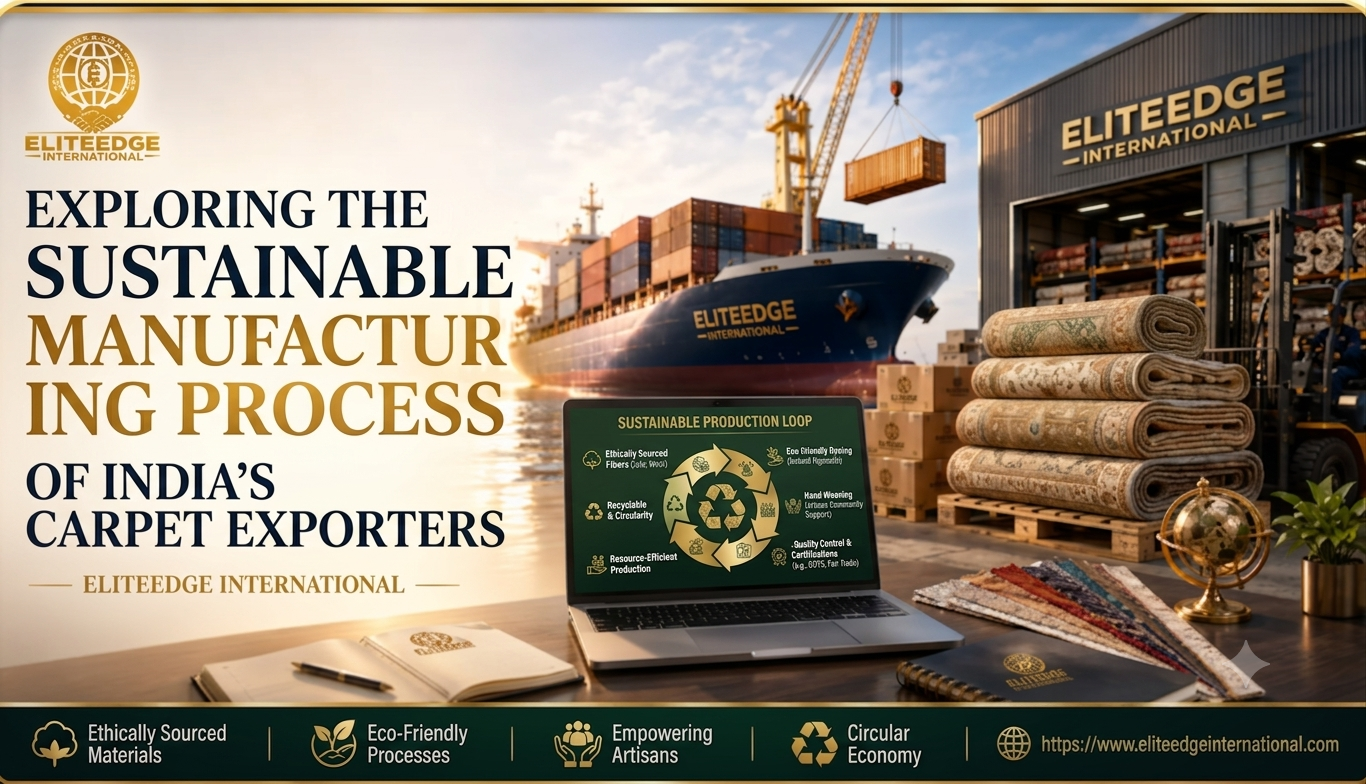
The sustainable carpet manufacturing process is best understood as a complete journey rather than a single production technique. It begins with responsible material selection and continues through yarn preparation, dyeing, weaving, energy management, water conservation, waste reduction, quality testing, ethical manufacturing, finishing, and packaging. India's carpet industry is already combining traditional craftsmanship with modern sustainability practices, and current government and industry initiatives show that green technology, recycling, resource efficiency, and international competitiveness are becoming increasingly connected. For international buyers searching for sustainable carpet exporters India, the most important factor is not a fashionable environmental claim but evidence of responsible manufacturing throughout the supply chain. Certifications, testing, traceability, factory practices, worker welfare, material documentation, and product durability should all be considered before making a sourcing decision. The best sustainable carpet supplier is one that understands that environmental responsibility and commercial success can support each other. When a carpet is made with carefully selected materials, efficient processes, responsible labor, strong quality control, and thoughtful packaging, sustainability becomes part of the product's value rather than merely part of its marketing story.
Frequently Asked Questions
1. What does sustainable carpet manufacturing mean?
Sustainable carpet manufacturing means producing carpets while deliberately reducing unnecessary environmental and social impacts throughout the supply chain. It can involve responsible raw materials, recycled fibers, efficient water and energy use, reduced production waste, safer chemical management, ethical labor practices, durable product design, and environmentally conscious packaging. The exact approach varies according to the carpet's construction and intended application. A sustainable manufacturer should be able to explain its processes and provide appropriate documentation rather than relying only on general environmental claims. For international buyers, sustainability is strongest when material sourcing, factory practices, testing, certifications, and supply-chain information all support the same claim.
2. What materials are commonly used in sustainable carpets?
Sustainable carpet collections may use wool, cotton, jute, hemp, other natural fibers, recycled polyester, recycled polypropylene, recycled PET, and other responsibly sourced or recycled materials. The best material depends on the intended application and required performance. Natural fibers can provide distinctive texture and comfort, while recycled synthetic fibers can offer durability and help incorporate existing materials into new products. Certifications such as GRS or RWS can provide additional evidence for specific material claims. Buyers should always ask for the exact fiber composition and supporting documentation rather than assuming that a material is automatically sustainable.
3. How do Indian carpet exporters reduce environmental impact?
Indian manufacturers can reduce environmental impact through several approaches, including recycled materials, natural fibers, efficient machinery, renewable energy, water recycling, waste recovery, responsible dyeing, and optimized packaging. Industry examples in India include solar-energy systems, water recycling, recycled-material development, and efforts to optimize raw-material and energy consumption. Government initiatives are also encouraging green technology, recycling, and waste reduction across textile production. The exact practices differ between factories, so buyers should evaluate each supplier individually.
4. Which certifications should carpet buyers look for?
The appropriate certification depends on the buyer's sustainability requirements and target market. GRS can support claims related to recycled content and responsible processing, OEKO-TEX Standard 100 addresses harmful substances, and RWS relates to responsible wool production. GoodWeave focuses strongly on ethical labor conditions in relevant carpet supply chains. ISO, SEDEX, SMETA, SA8000, and BSCI may provide additional information about quality, environmental management, social responsibility, or supply-chain practices. Buyers should check the scope, validity, facility, and product coverage of every certificate.
5. Why should international buyers consider sustainable carpet exporters India?
India combines a long history of carpet craftsmanship with an established export ecosystem and increasingly sophisticated sustainability practices. CEPC supports a large network of Indian carpet exporters and promotes international market access, quality improvement, capacity building, and sustainable business practices. Buyers can source handmade and machine-made carpets, customized products, natural and recycled-material collections, and products designed for different commercial applications. By selecting an exporter with transparent processes, appropriate certifications, strong quality control, and reliable export capabilities, international buyers can develop carpet collections that combine Indian craftsmanship with modern sustainability expectations.